

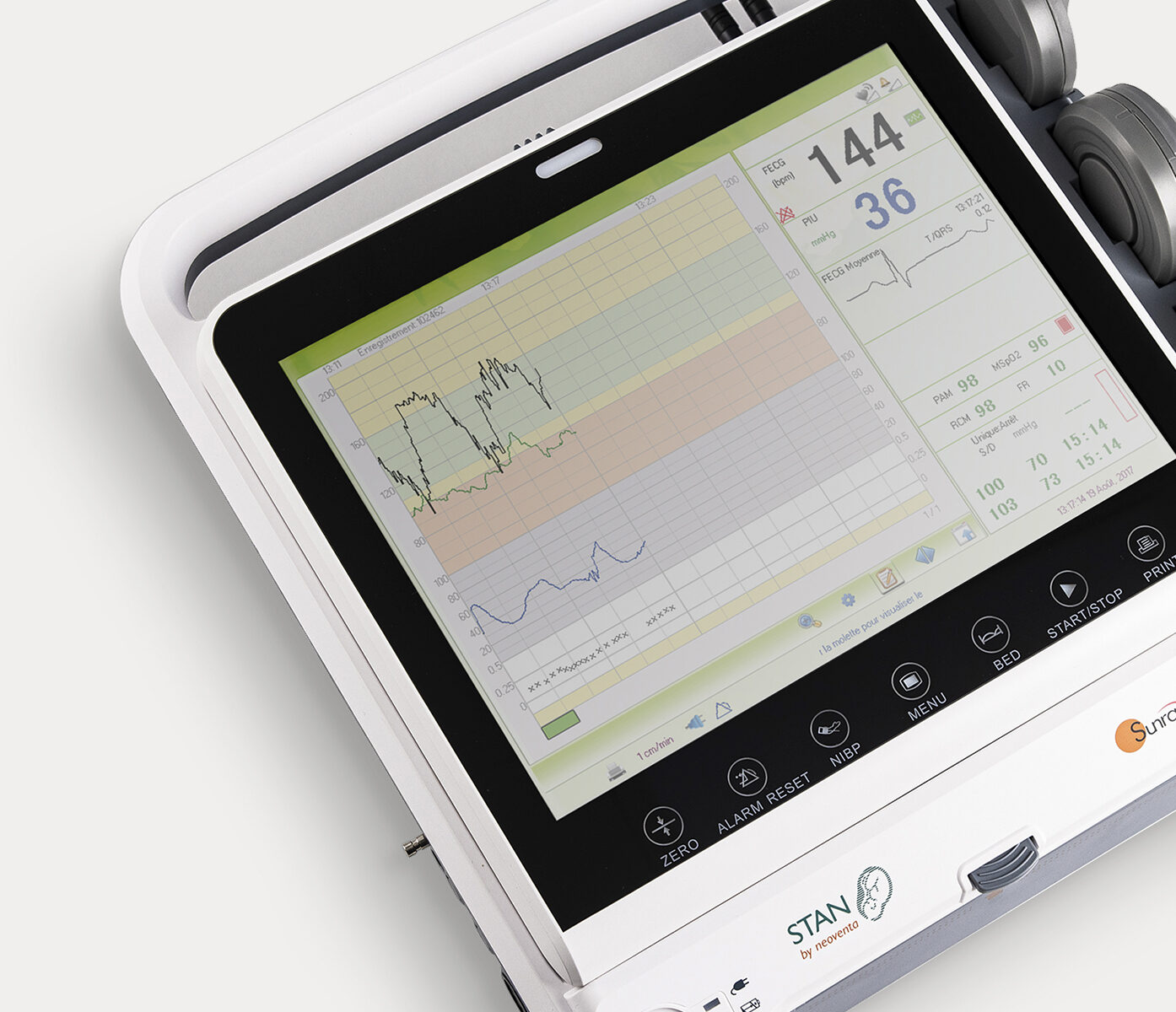
What is it and why does it matter?
• CTG: shows the fetal heart rate (FHR) + intrauterine contractions.
• STAN methodology: considers the CTG + analyzes changes in the ECG waveform (ST analysis) and includes further training & guidelines for labor management and clinical interventions.

By providing clinicians with more information about the fetal state during labor, fetuses at true risk can be detected, and unnecessary interventions are avoided.
The combination of ST analysis and standard CTG parameters provides extended information about the fetus during labor. This makes it a more comprehensive tool for assessing a fetus’s wellbeing during labor compared to CTG alone.

The STAN methodology is based on 50 years of research
Early research demonstrated that ST analysis of the fetal ECG alone would not provide sufficient information to determine if a fetus is fit for labor. This is due to factors such as signal difficulties, ST rises occurring in non-hypoxic situations, and cases where anaerobic resources had already been depleted before monitoring began. Therefore, the combination of FHR and fetal ECG waveform analysis has always been crucial in creating a broader clinical picture. As a result, the STAN methodology places a strong emphasis on education in fetal physiology and FHR interpretation.
References
Alfirevic Z, Devane D, Gyte GM, Cuthbert A. Continuous cardiotocography (CTG) as a form of electronic fetal monitoring (EFM) for fetal assessment during labour. Cochrane Database Syst Rev. 2017 Feb 3;2(2):CD006066. doi: 10.1002/14651858.CD006066.pub3. PMID: 28157275; PMCID: PMC6464257.
NHS Resolution. Five years of cerebral palsy claims: A thematic review of NHS Resolution’s Early Notification Scheme. London: NHS Resolution; 2022.
Rosén KG, Kjellmer I. Changes in the fetal heart rate and ECG during hypoxia. Acta Physiol Scand. 1975 Jan;93(1):59-66. doi: 10.1111/j.1748-1716.1975.tb05790.x. PMID: 1155132.
Amer-Wåhlin I, Ugwumadu A, Yli BM, Kwee A, Timonen S, Cole V, Ayres-de-Campos D, Roth GE, Schwarz C, Ramenghi LA, Todros T, Ehlinger V, Vayssiere C; Study Group of Intrapartum Fetal Monitoring (European Association of Perinatal Medicine). Fetal electrocardiography ST-segment analysis for intrapartum monitoring: a critical appraisal of conflicting evidence and a way forward. Am J Obstet Gynecol. 2019 Dec;221(6):577-601.e11. doi: 10.1016/j.ajog.2019.04.003.
Norén H, Carlsson A. Reduced prevalence of metabolic acidosis at birth: an analysis of established STAN usage in the total population of deliveries in a Swedish district hospital. Am J Obstet Gynecol. 2010 Jun;202(6):546.e1-7. doi: 10.1016/j.ajog.2009.11.033. Epub 2010 Jan 15. PMID: 20079889.
Amer-Wåhlin I, Hellsten C, Norén H, Hagberg H, Herbst A, Kjellmer I, Lilja H, Lindoff C, Månsson M, Mårtensson L, Olofsson P, Sundström A, Marsál K. Cardiotocography only versus cardiotocography plus ST analysis of fetal electrocardiogram for intrapartum fetal monitoring: a Swedish randomised controlled trial. Lancet. 2001 Aug 18;358(9281):534-8. doi: 10.1016/s0140-6736(01)05703-8. PMID: 11520523.”
Luzietti R, Erkkola R, Hasbargen U, Mattsson LA, Thoulon JM, Rosén KG. European Community multi-Center Trial “Fetal ECG Analysis During Labor”: ST plus CTG analysis. J Perinat Med. 1999;27(6):431-40. doi: 10.1515/JPM.1999.058. PMID: 10732301.