


What is ST analysis?
The fetal ECG and ST analysis concept is based on the unique ability of the ST interval to reflect the function of the fetal heart muscle (myocardium) during stress. In adult cardiology, ST analysis is performed to assess and diagnose myocardial insufficiency. During labor, we can continuously assess the condition of the fetus by monitoring and analyzing the electrocardiogram.

ECG complex
A spiral electrode is required to obtain the fetal ECG for ST analysis. The ECG is a reflection of the electrical currents generated by the heart muscle, the myocardium. The first waveform, the P wave, corresponds to the contraction of the atria. The next phase is the contraction of the ventricles, which corresponds to the QRS complex. The final component is the T wave, which corresponds to the regeneration of myocardial membrane potentials as the heart prepares for the next beat. The QRS complex is very robust and is ideal for accurate heart rate recording. By measuring the time between two consecutive heartbeats (the RR interval), the fetal heart rate can be obtained.
A standard CTG monitor only utilizes the RR interval of the ECG. ST analysis combines RR interval measurements with assessments of changes in the ST interval. The ratio between the height of the T wave and the QRS amplitude provides the T/QRS ratio, which serves as an accurate measurement of changes in T-wave height.

Improved decision-making
The fetal ECG contains a lot of useful information, after many years or research and development we have been able to use this knowledge and information to its fullest extent. Thanks to technical development, the signal processing technology is able to accurately record the fetal ECG waveform. The condition of the fetal heart reflects the condition of the brain, and the ST waveform reflects the energy balance in the myocardium.
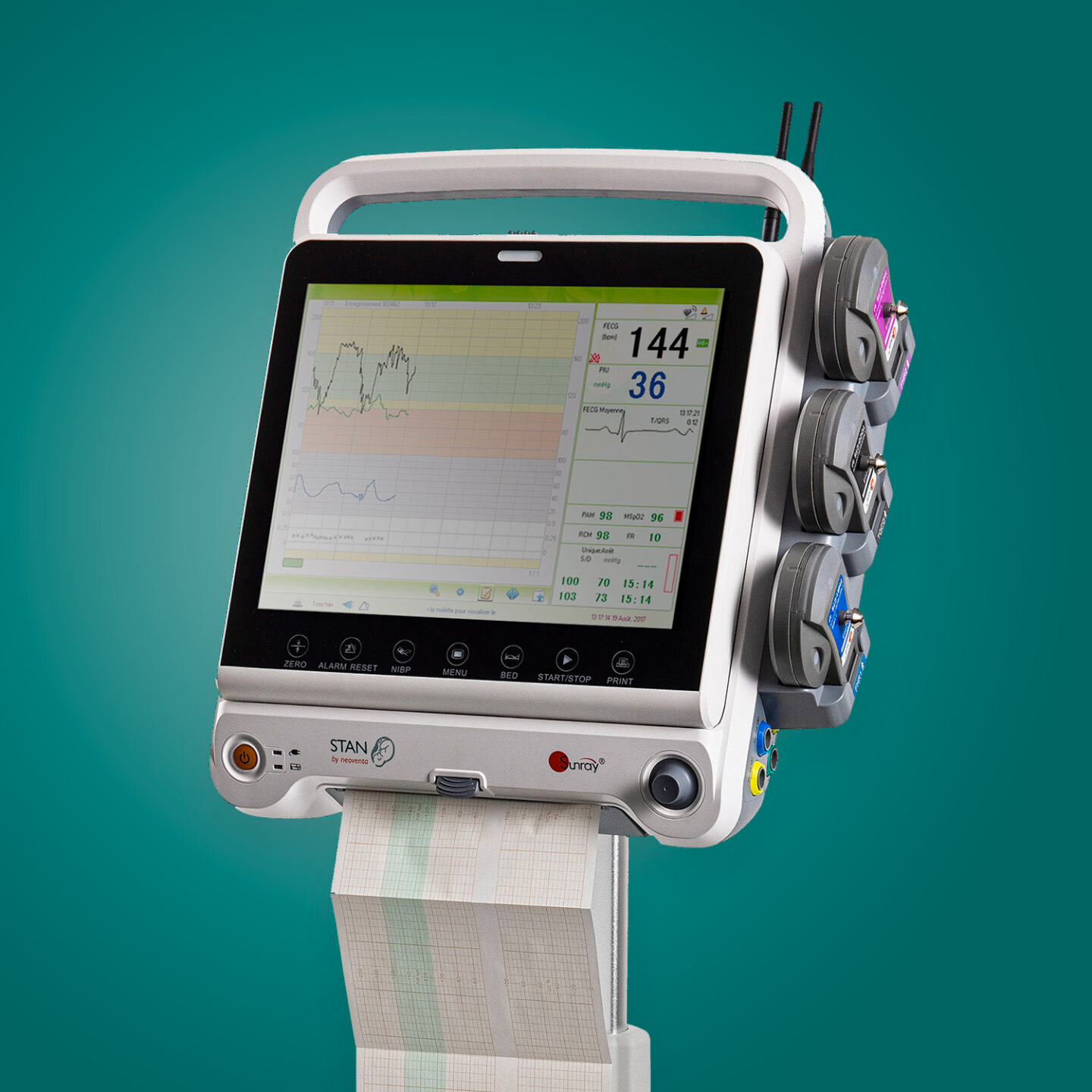
Stan S41
At the heart of Neoventa’s offering lies the Stan S41, a maternal and fetal monitor with all the standard CTG functions and he option of ST analysis.
References
Amer-Wåhlin I, Ugwumadu A, Yli BM, Kwee A, Timonen S, Cole V, Ayres-de-Campos D, Roth GE, Schwarz C, Ramenghi LA, Todros T, Ehlinger V, Vayssiere C; Study Group of Intrapartum Fetal Monitoring (European Association of Perinatal Medicine). Fetal electrocardiography ST-segment analysis for intrapartum monitoring: a critical appraisal of conflicting evidence and a way forward. Am J Obstet Gynecol. 2019 Dec;221(6):577-601.e11. doi: 10.1016/j.ajog.2019.04.003.
Rosén KG, Amer-Wåhlin I, Luzietti R, Norén H. Fetal ECG waveform analysis. Best Pract Res Clin Obstet Gynaecol. 2004 Jun;18(3):485-514. doi: 10.1016/j.bpobgyn.2004.02.008. PMID: 15183142.
Hökegård KH, Eriksson BO, Kjellmer I, Magno R, Rosén KG. Myocardial metabolism in relation to electrocardiographic changes and cardiac function during graded hypoxia in the fetal lamb. Acta Physiol Scand. 1981 Sep;113(1):1-7. doi: 10.1111/j.1748-1716.1981.tb06853.x. PMID: 7315431.